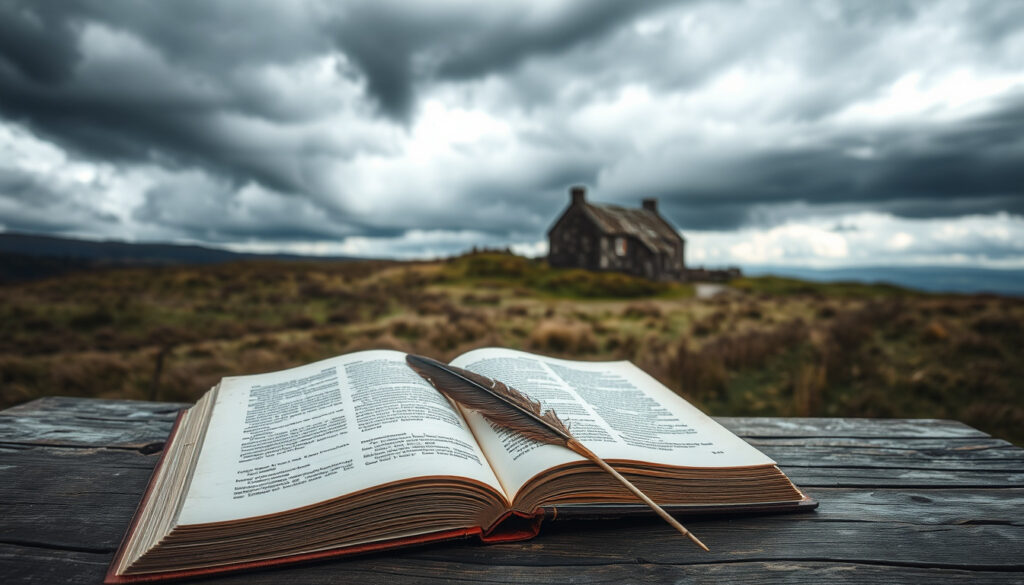
Emily Brontë: Life, Works, and Lasting Legacy
She published only one novel, yet her name sits alongside the greatest of English literature — and the mystery of why still pulls readers back 175 years later. Born on 30 July 1818, Emily Brontë wrote Wuthering Heights from a solitary parsonage, a blazing love story set against the wild Yorkshire moors that continues to captivate readers today.
Born: 30 July 1818 ·
Died: 19 December 1848 (aged 30) ·
Known for: Wuthering Heights (1847) ·
Number of novels: 1 ·
Poetry collection: Poems by Currer, Ellis, and Acton Bell (1846) ·
Genre: Gothic fiction, poetry
Quick snapshot
- Emily Brontë died of tuberculosis on 19 December 1848 (Encyclopaedia Britannica (reference work)).
- She published only one novel, Wuthering Heights, in 1847 (Smithsonian Magazine (history magazine)).
- She co-authored a poetry collection with her sisters Charlotte and Anne in 1846 (BBC History (public broadcaster)).
- She never married (Encyclopaedia Britannica).
- Whether she had any secret romantic attachment or relationship (Encyclopaedia Britannica).
- The exact cause of her extreme reclusiveness and reluctance to socialize (Smithsonian Magazine).
- The full extent of her involvement in the Gondal saga with her siblings (University of Delaware British Literature Wiki (academic resource)).
- 1818: Born in Thornton, West Yorkshire.
- 1846: Poetry collection published.
- 1847: Wuthering Heights released.
- 1848: Dies of tuberculosis, aged 30.
- Her novel continues to be adapted for film, TV, and stage.
- Scholars revisit her poetry for its proto-feminist and ecological themes.
- The Brontë Parsonage Museum remains a key destination for literary tourism.
Seven facts that define Emily Brontë’s life, drawn from authoritative sources:
| Label | Value |
|---|---|
| Full Name | Emily Jane Brontë |
| Birth | 30 July 1818, Thornton, West Yorkshire, England |
| Death | 19 December 1848, Haworth, West Yorkshire, England |
| Occupation | Novelist, Poet |
| Notable Works | Wuthering Heights, Poems by Currer, Ellis, and Acton Bell |
| Literary Movement | Romanticism, Gothic fiction |
| Genre | Gothic novel, Victorian literature |
What condition did Emily Brontë have?
What caused Emily Brontë’s death?
- Emily Brontë died of tuberculosis on 19 December 1848, according to Encyclopaedia Britannica (reference work).
- She caught a cold after her brother Branwell’s funeral, and the illness developed into tuberculosis (Smithsonian Magazine).
- Historical accounts note that she refused medical treatment as her condition worsened (Smithsonian Magazine).
The implication: Her refusal of treatment turned a manageable cold into a fatal illness, a decision that mirrors the uncompromising spirit of her writing.
Why were the Brontë sisters so often ill?
- The Brontë siblings suffered from various illnesses, likely due to poor living conditions, genetic predisposition, and the prevalence of tuberculosis in the 19th century (Encyclopaedia Britannica).
- Emily’s death came just five months before Anne Brontë died from the same disease (Smithsonian Magazine).
- Their father Patrick Brontë was an Anglican clergyman, and the family lived in a damp parsonage (Portuguese Wikipedia (encyclopedia)).
Emily Brontë’s refusal of medical treatment in her final days turned a manageable cold into a fatal illness. For a woman who wrote with such intensity about life and death, the decision to let nature take its course echoes the stark, uncompromising world of Wuthering Heights.
The pattern: The Brontë sisters’ health struggles were shaped by the material realities of their time — tuberculosis was a common killer, and the damp, overcrowded parsonage at Haworth likely accelerated its spread.
Did Emily Brontë write only one book?
Did Emily Brontë write any other books?
- Emily Brontë published only one novel, Wuthering Heights (1847) (Encyclopaedia Britannica).
- She co-authored a poetry collection with her sisters Charlotte and Anne under the pseudonyms Currer, Ellis, and Acton Bell (BBC History).
- She wrote nearly 200 poems, though only a fraction were published in her lifetime (University of Delaware British Literature Wiki).
Is Wuthering Heights her only novel?
- Yes, Wuthering Heights is her only published novel (Smithsonian Magazine).
- It was published under the pen name Ellis Bell (Britannica Kids (educational resource)).
- The novel was published in December 1847, a year before her death (Encyclopaedia Britannica).
The pattern: Emily Brontë’s output was small in volume but immense in impact. Her poetry, often overshadowed by the novel, contains some of the most passionate verse of the 19th century.
Did Emily Brontë ever have a relationship?
Did any of the Brontë sisters marry?
- Emily Brontë never married and had no known romantic relationships (Encyclopaedia Britannica).
- Charlotte Brontë married Arthur Bell Nicholls in 1854 (Encyclopaedia Britannica).
- Anne Brontë never married (Encyclopaedia Britannica).
Did Emily Brontë have a husband?
- No, she remained single throughout her life (Encyclopaedia Britannica).
- The question of a secret relationship persists, but no evidence has been found (Smithsonian Magazine).
Emily Brontë’s solitary life gave her the space to create a world as intense as any in English literature. But for readers, the silence around her personal life remains a frustrating gap — one that biographers may never fully fill.
The catch: We know more about the fictional loves of Catherine Earnshaw and Heathcliff than we do about Emily Brontë’s own heart. That void has only added to her mystique.
What was Emily Brontë’s famous line?
Which Brontë sister is considered the best writer?
- Many critics consider Emily the most gifted Brontë sister. Charlotte herself called her sister “a genius” (Encyclopaedia Britannica).
- Her most famous line from Wuthering Heights: “Whatever our souls are made of, his and mine are the same” (Encyclopaedia Britannica (literary analysis)).
- Another iconic line: “I am Heathcliff” — spoken by Catherine Earnshaw (Encyclopaedia Britannica).
What is Emily Brontë’s most famous quote?
- “Whatever our souls are made of, his and mine are the same” is widely cited (Encyclopaedia Britannica).
- Her poem “No Coward Soul Is Mine” contains the line: “No coward soul is mine, no trembler in the world’s storm-troubled sphere” (Poetry Foundation (poetry archive)).
Why this matters: Emily Brontë’s lines have entered the cultural lexicon not because they are clever, but because they articulate a vision of love that transcends death — a theme that resonates across centuries.
Who inherited the Brontë money?
Who inherited the Brontë estate after their deaths?
- After the deaths of the Brontë siblings, the family estate passed to their father, Patrick Brontë (Encyclopaedia Britannica (biography of Patrick Brontë)).
- After Patrick’s death in 1861, the estate was inherited by Arthur Bell Nicholls, Charlotte’s husband (Encyclopaedia Britannica).
- The Brontë Parsonage Museum, formerly the family home, now houses the world’s largest collection of Brontë manuscripts and artifacts (Brontë Parsonage Museum (official museum site)).
The pattern: The Brontë family fortune was modest — a clergyman’s salary and proceeds from book sales. What endured was not money but legacy: the parsonage became a shrine to the sisters’ literary achievements.
Brontë sisters at a glance: a comparison
Three sisters, three distinct voices, one shared literary revolution. The table below shows how their lives and works compare.
| Sister | Born | Died | Notable Works | Married? |
|---|---|---|---|---|
| Charlotte Brontë | 21 April 1816 | 31 March 1855 | Jane Eyre (1847), Shirley (1849), Villette (1853) | Yes (Arthur Bell Nicholls, 1854) |
| Emily Brontë | 30 July 1818 | 19 December 1848 | Wuthering Heights (1847), poetry | No |
| Anne Brontë | 17 January 1820 | 28 May 1849 | Agnes Grey (1847), The Tenant of Wildfell Hall (1848) | No |
Timeline: Emily Brontë’s life in eight dates
- 30 July 1818: Emily Jane Brontë born in Thornton, West Yorkshire.
- 1820: Family moves to Haworth Parsonage.
- 1824–1825: Attends Cowan Bridge School with Charlotte and older sisters.
- 1835–1838: Teaches at Law Hill School, Halifax.
- 1842–1843: Studies in Brussels with Charlotte.
- 1846: Poems by Currer, Ellis, and Acton Bell published.
- December 1847: Wuthering Heights published under the pseudonym Ellis Bell.
- 19 December 1848: Emily Brontë dies of tuberculosis.
All dates sourced from Encyclopaedia Britannica and Smithsonian Magazine.
What we know — and what we don’t
Confirmed facts
- Emily Brontë died of tuberculosis.
- She published only one novel, Wuthering Heights.
- She never married.
- She co-authored a poetry collection with her sisters.
What’s unclear
- Whether she had any secret romantic relationship or attachment.
- Exact cause of her extreme reclusiveness and reluctance to socialize.
- The full extent of her involvement in the Gondal saga.
Voices from the page
Whatever our souls are made of, his and mine are the same.
— Catherine Earnshaw, Wuthering Heights (1847)
No coward soul is mine, no trembler in the world’s storm-troubled sphere.
— Emily Brontë, “No Coward Soul Is Mine” (1846)
Stronger than a man, simpler than a child, her nature stood alone.
— Charlotte Brontë, in the preface to Wuthering Heights (1850 edition)
For readers and scholars alike, the enduring riddle of Emily Brontë is a reminder that the most powerful voices often emerge from the most solitary lives. The choice to remain a mystery may have been the most deliberate act of her creative life.
britannica.com, en.wikipedia.org, studysmarter.co.uk, youtube.com, youtube.com, literaryladiesguide.com
Frequently asked questions
What is the setting of Wuthering Heights?
The novel is set on the Yorkshire moors, primarily at two estates: Wuthering Heights and Thrushcross Grange (Encyclopaedia Britannica).
How old was Emily Brontë when she started writing?
She began writing poetry and stories as a child, likely in her early teens, as part of the Gondal saga with her siblings (University of Delaware British Literature Wiki).
What was the Brontë family’s home like?
The family lived in Haworth Parsonage, a damp, stone house adjacent to the churchyard, with limited amenities (Brontë Parsonage Museum).
Did Emily Brontë have any pets?
Yes, she had a dog named Keeper, who was known to be fiercely loyal (Brontë Parsonage Museum).
What is the significance of the pseudonym ‘Ellis Bell’?
Emily used the male pseudonym Ellis Bell to avoid the prejudice against female authors in the 19th century (BBC History).
Was Emily Brontë religious?
Her poem “No Coward Soul Is Mine” reveals a deeply personal, almost pantheistic faith, though she was not conventionally religious (Poetry Foundation).
How did the Brontë sisters learn to write?
They were educated at home by their father and at a school for clergy daughters, and they read widely from the family library (Encyclopaedia Britannica).
What is the role of nature in Emily Brontë’s writing?
Nature is a central force in Wuthering Heights and her poetry, often symbolizing freedom, passion, and the sublime (Encyclopaedia Britannica).
More related posts
 Bethany Joy Lenz: Cult, Divorce, Feuds, and New Book Explained
 Aimee Lou Wood: Natural Teeth, Career & Personal Life
 Where is Dubai? Country, Continent, and World Map Location
 Jesus Christ: Historical Facts, Myths, and Key Questions Answered
 Leander Change Mat – Guide to Features, Sizes and Care
 Macaulay Culkin: Net Worth, Family, and Legal Facts
 Uncle Jack Charles – Life, Legacy and Indigenous Activism
 Singapore Airlines: 2025 Contact, Flight Status & Baggage Guide