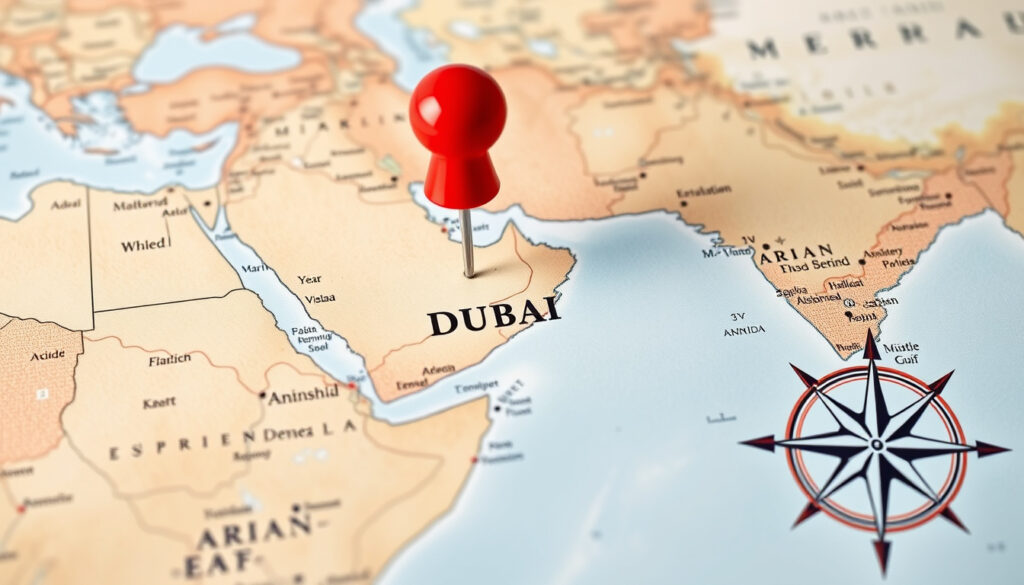
Where is Dubai? Country, Continent, and World Map Location
If someone asked you to point to Dubai on a map, you’re not alone if the answer is fuzzy — the city’s global fame has blurred its actual coordinates. This article separates geographic fact from cultural rumor, showing exactly where Dubai sits on the world map and what that location means for visitors navigating dress codes, gestures, and public behavior.
Population (2024 est.): 3.6 million · Urban area: 3,885 sq km · Elevation above sea level: 16 m (52 ft) · Location: Persian Gulf coast of the Arabian Peninsula · Country: United Arab Emirates
Quick snapshot
- Persian Gulf coast (Encyclopaedia Britannica)
- Part of Arabian Peninsula (Encyclopaedia Britannica) (Encyclopaedia Britannica)
- Elevation: 16 m (CIA World Factbook)
- United Arab Emirates (UAE Government Portal)
- Western Asia (Middle East) (Encyclopaedia Britannica) (UAE Government Portal)
- Dress modestly in public (Visit Dubai)
- Three-finger salute is a symbol of unity (Sheikh Mohammed bin Rashid Al Maktoum)
- Avoid public displays of affection (UAE Government Portal)
- Not in Saudi Arabia (CIA World Factbook)
- Not in India or Iran (Encyclopaedia Britannica)
- Not the capital of UAE (UAE Government Portal)
Dubai’s identity is best understood through these key attributes.
| Attribute | Value |
|---|---|
| Location | Southeast coast of the Persian Gulf |
| Country | United Arab Emirates |
| Continent | Asia (Middle East) |
| Official Language | Arabic |
| Currency | UAE dirham (AED) |
| Government | Constitutional monarchy (emirate) |
What country is Dubai in?
Dubai is a city and an emirate within the United Arab Emirates — it is not a country. The UAE, a federation of seven emirates, sits on the eastern end of the Arabian Peninsula in West Asia, as confirmed by Encyclopaedia Britannica. Each emirate retains its own local government, but federal law governs matters like public decency and criminal justice.
Where is Dubai located in which continent?
Dubai lies in Asia — specifically in the region commonly called the Middle East, which is part of Western Asia. The CIA World Factbook places the UAE within Asia, bordered by Oman and Saudi Arabia, with coastlines on both the Persian Gulf and the Gulf of Oman.
- Continent: Asia (Western Asia / Middle East).
- Neighboring countries: Oman to the east and southeast; Saudi Arabia to the south and west.
- Water bodies: Persian Gulf (north and west coast); Gulf of Oman (east coast).
Dubai is capital of which country?
Dubai is not the capital of the UAE. The capital is Abu Dhabi, which hosts the federal government and the presidential palace. According to the UAE Government Portal, each emirate — including Dubai — has its own ruler and local administration, but Abu Dhabi is the political and administrative capital.
Dubai’s status as the most populous city in the UAE sometimes tricks travelers into thinking it holds the nation’s capital. But the center of federal power lies 140 km southwest in Abu Dhabi — a distinction that affects where visitors go for visa processing and government services.
The implication: Dubai’s status as a non-capital city often surprises visitors, but federal services are centralized in Abu Dhabi.
Where is Dubai on the world map?
Dubai sits at approximately 25.2°N latitude and 55.3°E longitude — coordinates that place it on the southeastern coast of the Persian Gulf. The city lies at roughly sea level, with an average elevation of just 16 meters (52 feet), according to the CIA World Factbook. On a world map, locate the Arabian Peninsula pointing into the Persian Gulf; Dubai is on that Gulf coast, east of Qatar and north of Oman.
What are the geographic coordinates of Dubai?
Eighteen facts, one pattern: everything about Dubai’s location is coastal and low-lying.
| Coordinate / measurement | Value | Source |
|---|---|---|
| Latitude | 25.2° N | Encyclopaedia Britannica |
| Longitude | 55.3° E | Encyclopaedia Britannica |
| Average elevation | 16 m (52 ft) | CIA World Factbook |
| Distance from Abu Dhabi | ~140 km southwest | Encyclopaedia Britannica |
The implication: Dubai’s flat, coastal geography shapes its climate (hot, humid summers) and its urban expansion — the city has grown inland along artificial canals and islands because there are no natural hills to stop it.
Is Dubai in Saudi Arabia?
No — this is the single most common misconception about Dubai’s location. Dubai is in the United Arab Emirates, not Saudi Arabia. The two countries share a land border (the UAE sits southeast of Saudi Arabia), but Dubai is firmly inside Emirati territory. The CIA World Factbook confirms the UAE’s borders: Oman to the east, the Persian Gulf to the north, and Saudi Arabia to the south and west.
A traveler who books a flight to Saudi Arabia expecting to arrive in Dubai will land in Riyadh or Jeddah — about 1,000 km away. The two countries have separate visa systems, different alcohol laws, and distinct cultural norms.
Where is Dubai in India?
Dubai is not in India. The confusion likely arises because of the large Indian expatriate population in Dubai — Indians make up roughly 27% of the city’s residents. But geographically, Dubai is about 2,500 km west of Mumbai, across the Arabian Sea. Encyclopaedia Britannica places Dubai firmly in West Asia, not South Asia.
Where is Dubai located in Iran?
Dubai is not in Iran either. The closest Iranian territory lies about 180 km north across the Persian Gulf. Iran and the UAE share maritime borders in the Gulf, but Dubai is on the Arabian (southern) side. The CIA World Factbook notes that Iran is separated from the UAE by the Strait of Hormuz and the Persian Gulf itself.
The pattern: Common geographic misconceptions about Dubai can lead to travel booking errors, confirming the need to verify location before planning.
What to Wear in Dubai?
Dubai’s dress code is a frequent source of anxiety for first-time visitors, but the official guidance is clearer than many travelers expect. The Visit Dubai website states that tourists are expected to dress modestly in public places — especially in malls, government buildings, and religious sites. Shoulders and knees should be covered in those settings.
Can you wear jeans in Dubai?
Yes — jeans are perfectly acceptable in most public places across Dubai. You’ll see locals and tourists alike wearing them in malls, restaurants, and on the street. The key distinction is not about denim but about coverage: the Visit Dubai guidance emphasizes avoiding clothing that is overly revealing, such as bare shoulders, short shorts, or low-cut tops in public areas away from beaches and pools.
- Malls and restaurants: Jeans, t-shirts, sundresses — all fine.
- Mosques and government buildings: Full coverage required (arms, legs, headscarf for women at mosques).
- Beaches and pools: Swimwear is allowed, but cover up when walking to and from the water.
- Streets and public transport: Avoid swimwear, bare chests, and very short shorts.
What is “acceptable” legally and what is “acceptable” socially are not the same in Dubai. The UAE Government Portal frames public decency as a legal issue — meaning a complaint from a local can escalate into a police matter, even if the clothing technically meets legal standards. Err on the conservative side in public areas.
The catch: Dress code expectations in Dubai are not just social; they can become legal matters if complaints arise.
What does 3 fingers in Dubai mean?
The three-finger salute — thumb, index, and middle finger extended together — is a well-known gesture in the UAE, symbolizing unity, peace, and the three core values of the nation. It was popularized by Sheikh Mohammed bin Rashid Al Maktoum, the Vice President and Prime Minister of the UAE and ruler of Dubai. The gesture appears in official government communications and at public events.
What does 🤏 🤏 🤏 mean?
The pinch emoji (🤏) is unrelated to the three-finger salute. In general usage across messaging apps, 🤏 means “a little” or “small.” Using it in conversation about Dubai suggests something tiny or close, not a political or cultural statement. Some visitors mistakenly associate the emoji with the three-finger gesture because of visual similarity, but they carry entirely different meanings.
Do not use the three-finger salute casually as a joke or imitation. While the gesture itself is positive, disrespectful use — especially if mocked or paired with offensive commentary — can be treated as a breach of public decency under UAE law. The UK Foreign, Commonwealth & Development Office advises that local customs and symbols should be treated with respect.
The principle: Cultural symbols require respect, as misuse may have legal consequences.
Can I kiss my husband in public in Dubai?
Public displays of affection — including kissing and hugging — are not explicitly illegal under federal UAE law, but they can attract legal attention if a complaint is made. The UAE Government Portal states that public decency is a legal responsibility, not merely a social expectation. Discreet pecks on the cheek are generally tolerated in tourist areas, but overt kissing is strongly advised against.
Can I kiss my wife in public in Dubai?
The same guidance applies regardless of gender or marital status. The UK Foreign, Commonwealth & Development Office notes that kissing and overt hugging in public can attract police attention depending on the circumstances. In practice, couples who hold hands or exchange a brief kiss on the cheek in a shopping mall are rarely approached, but a prolonged or passionate kiss in a public square can lead to a complaint.
- Hand-holding: Generally fine in tourist areas.
- Quick peck on the cheek: Tolerated but not guaranteed.
- Overt kissing or hugging: Not recommended; can attract complaints.
- Private settings (hotels, resorts): No restrictions.
The bottom line: Public behavior in Dubai is guided by a mix of law and social expectation, making discretion the safest approach.
Confirmed facts vs. what’s unclear
Confirmed facts
- Dubai is in the United Arab Emirates (UAE Government Portal).
- Dubai is on the Persian Gulf (Encyclopaedia Britannica).
- Three-finger salute is a symbol of unity used by UAE leaders (Sheikh Mohammed bin Rashid Al Maktoum).
- Tourists can wear jeans in most public areas (Visit Dubai).
What’s unclear
- Exact legal penalties for public kissing are not consistently enforced — depends on the complainant and the officer’s judgment (UK Foreign, Commonwealth & Development Office).
- Origin of the three-finger gesture is disputed by some sources.
The pattern: Some aspects of Dubai’s cultural norms are clearly defined, while others depend on enforcement context.
Quotes from key sources
Dubai is a city and an emirate within the United Arab Emirates, not a country.
UAE Government Portal — official federation and constitution page
Tourists are expected to dress modestly in public places in Dubai, especially in malls, government buildings, and religious sites.
Visit Dubai — official tourism authority
Kissing and overt hugging in public can attract legal or police attention in the UAE depending on the circumstances.
UK Foreign, Commonwealth & Development Office — travel advice for UAE
The three-finger salute was popularized by Sheikh Mohammed bin Rashid Al Maktoum as a symbol of unity and peace.
Encyclopaedia Britannica — biography of the UAE Vice President
Summary: What this means for your trip
Dubai’s location on the Persian Gulf coast of the Arabian Peninsula — inside the United Arab Emirates, not Saudi Arabia, India, or Iran — shapes every aspect of a visitor’s experience, from the climate to the cultural rules. The city’s geography explains why it is humid, flat, and built on artificial islands; its legal system explains why a three-finger salute carries political weight and why a public kiss can become a police matter. For the traveler planning a first visit, the choice is clear: learn the location and the local norms before you arrive, or risk a trip that is more complicated than it needs to be.
Related reading: Papua New Guinea Travel Guide · Nusa Dua Beach Bali Guide
whatarethe7continents.com, hotbot.com, onestep4ward.com, theglobetrottingdetective.com, en.wikipedia.org
While many travelers wonder where Dubai is located on the world map, it is important to understand that Dubai is an emirate in the UAE rather than an independent nation.
Frequently asked questions
What is the best time to visit Dubai?
November through March offers the most comfortable weather, with daytime highs around 25-30°C (77-86°F). Summer months (June-September) can exceed 45°C (113°F), making outdoor activities difficult.
Is Dubai safe for tourists?
Yes. Dubai has a very low crime rate, and violent crime against tourists is extremely rare. Petty theft is uncommon in tourist areas. The main safety concerns relate to traffic and cultural misunderstandings rather than crime.
Do I need a visa to visit Dubai?
Citizens of many countries — including the US, UK, Canada, Australia, and most EU nations — receive a free 30-day or 90-day tourist visa on arrival. Check the Visit Dubai visa page for your specific nationality.
What is the official language of Dubai?
Arabic is the official language. English is widely spoken in business, tourism, and daily life — most signs are bilingual.
What is the currency used in Dubai?
The UAE dirham (AED) is the currency. ATMs are widely available, and credit cards are accepted in most hotels, malls, and restaurants.
Is Dubai expensive for tourists?
It depends on your choices. Luxury hotels and fine dining are expensive, but mid-range accommodation and street food can be very affordable. The city caters to all budgets, though alcohol carries high taxes.
Can I drink alcohol in Dubai?
Yes — alcohol is available in licensed hotels, bars, and restaurants. Drinking in public (streets, beaches, parks) is illegal. The legal drinking age is 21.
Related reading
- Encyclopaedia Britannica: Dubai — comprehensive geography and history
- UAE Government Portal: Federation and Constitution — official explanation of emirates system
- UK Government Travel Advice: UAE Local Laws — official guidance for British travelers
- Visit Dubai: Essential Information — official tourist dress code and behavior guidance
- CIA World Factbook: United Arab Emirates — government-sourced geographic and demographic data
More related posts
 Bethany Joy Lenz: Cult, Divorce, Feuds, and New Book Explained
 Hogwarts Legacy Switch – Native Port Performance Guide
 Michael Franzese: From Mafia Caporegime to YouTuber and Author
 Taylor Kinney: Lady Gaga Engagement, Chicago Fire Exit, Life Now
 DKK to AUD: Why Danish Krone is Stronger & Exchange Rate Guide
 Janis Joplin: Cause of Death, Last Words, and Legacy
 Hideo Kojima: Biography, Games, Net Worth, Konami Split
 Kirby Howell-Baptiste: Killing Eve, Sandman, Good Place