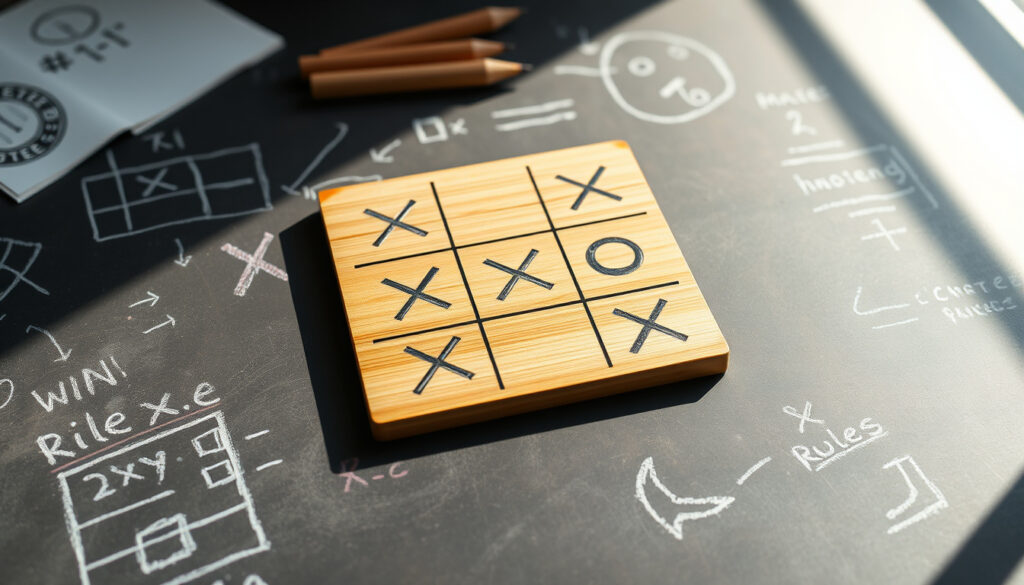
Tic-Tac-Toe Rules: How to Play, Strategies & Variants
You probably sketched a 3×3 grid on scrap paper before you could ride a bike. Tic-tac-toe has been a childhood rite of passage for generations—but the game stretches back much further than childhood memories, with roots reaching to ancient Egypt around 1300 BCE and an early digital life in 1952’s OXO computer game. Beyond the familiar quick draw, the game hides surprising strategic depth, countless variants, and modern multiplayer twists worth exploring.
Standard Grid Size: 3×3 · Number of Players: 2 · Symbols Used: X and O · Win Condition: Three in a row · Alternative Names: Noughts and Crosses
Quick snapshot
- 4×4 grids, football themes, mega 100×100 challenges (Upepo)
- Ultimate Tic Tac Toe, 3D boards, Misère rules (Infinitely More)
The table below summarizes the core facts about tic-tac-toe’s origins and gameplay.
| Fact | Details |
|---|---|
| Origin | Ancient, paper-and-pencil (Egyptian tiles from Ming Productions) |
| Players | 2 |
| Grid | Typically 3×3 |
| Solved Status | Draw with perfect play (Byrdseed) |
How to Play Tic Tac Toe Game
Grid setup
The classic tic-tac-toe board is a simple 3×3 grid, producing nine squares where players take turns placing their marks. This straightforward setup is part of a broader family of m,n,k-games where players alternate on an m×n board to get k marks in a row (Wikipedia — Tic-tac-toe variants). The grid can be drawn with pencil and paper in seconds, or displayed on a digital screen.
Turn rules
Two players compete, one using X and the other using O. The player with X typically moves first, though this convention can be flipped by mutual agreement. Players alternate placing one mark per turn on any empty square. Ancient Roman variant Terni Lapilli used a different system: players each had three fixed pieces that had to be moved to adjacent spots rather than placed freely (Wikipedia — Tic-tac-toe variants).
Win conditions
A player wins by forming a horizontal, vertical, or diagonal line of three of their symbols. If all nine squares fill with no winner, the game ends in a draw. Standard tic-tac-toe is solved in seconds with perfect play—it always ends in a draw when both players avoid mistakes (Byrdseed). The mathematician John von Neumann applied minimax strategy to prove this optimal play principle, foundational to game theory (Jesper Juul (Ludologist)).
Perfect play leads to a draw, but most casual games don’t reach perfection—most people make at least one mistake that tips the outcome.
For readers exploring similar strategic games, the Unsolved Case Files board game offers a different kind of deduction challenge.
Tic Tac Toe Multiplayer
Local two-player mode
The original multiplayer setup requires nothing more than pencil, paper, and two players sitting across from each other. Local play remains the purest form of the game, letting opponents read body language and adopt psychological tactics. When the first player places a mark in the top-left corner, the responding player can safely counter in the middle-right or bottom-middle positions (Erich Friedman (Mathematical Research)).
Online multiplayer options
Modern platforms extend tic-tac-toe into real-time online play against friends or random opponents. Browser-based implementations through sites like Poki and dedicated apps allow matches without downloads or account creation. Google Tic Tac Go offers quick matchmaking directly through search, letting players challenge opponents instantly (Wikipedia). The shift to digital multiplayer has revived interest in the classic format, especially as a gateway to deeper strategy games.
Online multiplayer transforms the solo experience into a social one, with leaderboards and ranked modes adding stakes to the ancient paper-and-pencil game.
The implication: digital platforms have democratized access to competitive play, letting anyone with a browser challenge strangers worldwide in seconds.
Tic Tac Toe 4×4 and Larger Variants
4×4 rules
The 4×4 variant expands the grid to sixteen squares, typically requiring four-in-a-row to win. This version offers more strategic complexity, though mathematicians have proven through the strategy-stealing argument that the first player maintains an advantage or forces a draw—no benefit exists for going second (Infinitely More by Joel David Hamkins (Mathematics)). Some 4×4 rule sets award points for controlling four corners or alternate win conditions, adding variety.
100×100 challenges
At the extreme end, players attempt tic-tac-toe on massive grids like 100×100—a version that would require extraordinary patience and strategic thinking. These enormous variants exist primarily as curiosities or programming challenges rather than practical games. The related game Gomoku, widely played in Asia, uses a 15×15 board with win-by-five-in-a-row (exactly five; six does not count) (Byrdseed). Ultimate Tic Tac Toe adds its own twist: a 3×3 grid of 3×3 boards where winning three small games in a row claims the overall match (Upepo).
Larger grids don’t necessarily mean harder strategy—the math gets complex fast, and many oversized variants remain unsolved, making them active research areas for game theorists.
The pattern: variant designers push boundaries, but unsolved status creates fertile ground for mathematical research rather than casual play.
Tic Tac Toe Football
Football twist rules
Football-themed tic-tac-toe variants replace traditional marks with football imagery, field layouts, or player tokens. The Tiki-Taka-Toe variant applies soccer passing logic to the grid, where certain move sequences simulate build-up play. These themed editions serve as entry points for sports fans who might otherwise overlook the classic game, and they appear regularly in party game collections.
Online play
Football tic-tac-toe variants are available through various online game platforms, often featuring animated field graphics and sound effects. The digital versions typically include local two-player modes and online matchmaking, making them accessible for quick entertainment between activities. Search for “tic tac toe football” or “tiki tak toe” through gaming aggregators to find browser-based implementations.
These themed variants work best for casual play; competitive strategy differs little from standard tic-tac-toe mechanics.
The catch: football theming adds visual appeal but rarely changes the underlying strategy that experienced players already know.
Tic Tac Toe Poki and Online Platforms
Poki gameplay
Poki hosts multiple tic-tac-toe implementations ranging from minimalist paper versions to animated themed editions. The platform’s games load directly in browsers without installation, making them ideal for quick sessions during breaks. Features vary by game: some include difficulty settings, AI opponents, and achievement tracking, while others focus purely on two-player local matches.
Google Tic Tac Go
Google introduced Tic Tac Go as a quick-access game accessible through the search engine, designed for immediate play against AI or pass-and-play modes. This implementation proved popular enough to inspire clones and variations, demonstrating sustained public interest in the classic format. The game loads within search results, eliminating friction for casual players who want instant matches.
For gamers seeking other portable experiences, the Hogwarts Legacy Switch guide covers another title optimized for quick-play sessions.
How to Play: Step-by-Step
- Draw the grid: Sketch a 3×3 board, creating nine equal squares.
- Assign symbols: Decide who plays X (first) and who plays O (second).
- Alternate turns: Place one mark per turn on any empty square.
- Watch for three-in-a-row: Claim victory with horizontal, vertical, or diagonal alignment.
- Accept the draw: If the board fills with no winner, start a new round.
Confirmed facts
- Standard 3×3 rules universal across all platforms
- Two-player alternation is the established format
- Terni Lapilli grid markings found chalked throughout Rome
- OXO developed in 1952 by Sandy Douglas as first video game with perfect play (Wikipedia)
- Strategy-stealing argument applies to 4×4 variants
What’s unclear
- Exact ancient origins remain debated
- Whether Seega had spiritual significance in ancient Egypt
- Regional variant depth (Pada, Picaria) lacks documentation
What Experts Say
The very first traces of the game go back to Egypt, which has remnants of 3×3 game boards on roofing tiles from 1300 BCE.
— Ming Productions (Historical Research)
Standard tic-tac-toe is solved in seconds. These variants add real strategy and deeper thinking.
— Byrdseed (Educational Platform)
There is no advantage, I claim, to going second in 4 × 4 tic-tac-toe.
— Joel David Hamkins (Mathematician/Author)
The earliest verifiable 3×3 boards appeared on Egyptian roofing tiles from 1300 BCE, according to Ming Productions (Historical Research). The Roman Empire’s Terni Lapilli variant, dated to the 1st century BC, introduced moving-piece mechanics where players each controlled three tokens that slid to adjacent intersections instead of being placed freely. Three Men’s Morris—a related game requiring three-in-a-row on a simple grid—appeared in 14th century European manuscripts, indicating the game’s spread across continents and centuries. The earliest known English reference to “Noughts and Crosses” appeared in an 1858 tabloid publication, with the familiar song “Tit, Tac, Toe” following in 1876. Tick-tack, a backgammon variation described in 1558, may have influenced the modern game’s name.
For casual players, the choice is straightforward: open a browser, find a quick game, and enjoy a few rounds. For those seeking deeper engagement, the variant landscape—from 4×4 strategy-stealing debates to Ultimate Tic Tac Toe meta-gaming—offers years of unexplored territory. The ancient game that began on Egyptian roofing tiles has truly evolved into something for everyone.
Many players hone their skills using the Google Tic-Tac-Toe guide, activating a fun Tic-Tac-Toe game directly in Google’s search bar for instant practice.
Frequently asked questions
Is tic-tac-toe always a draw?
With perfect play from both sides, standard 3×3 tic-tac-toe always ends in a draw. Casual players usually make mistakes that allow one side to win, but optimal strategies negate any advantage.
Can computers beat tic-tac-toe?
Yes. Computers solve tic-tac-toe instantly using minimax algorithms. Every position evaluates to a known outcome—win, lose, or draw—based on perfect play from that point. Human players cannot beat properly programmed opponents.
What age is tic-tac-toe suitable for?
Children as young as 3-4 years old can learn basic tic-tac-toe, understanding the grid and turn-taking. Strategic depth develops around age 8-10 when children start recognizing blocking patterns.
How many squares in tic-tac-toe?
Classic tic-tac-toe uses a 3×3 grid containing nine squares. Variants expand this: 4×4 has 16 squares, Gomoku uses 15×15 (225 squares), and extreme variants like 100×100 contain 10,000 squares.
Does tic-tac-toe have official rules?
No formal governing body sets official tic-tac-toe rules. The 3×3 grid, two-player alternation, and three-in-a-row win condition are conventions established over centuries rather than codified regulations.
Why is it called tic-tac-toe?
The name likely evolved from “tick-tack,” a 1558 backgammon term for clicking pieces together, combined with “toy” or an equivalent. The phrase “tit, tac, toe” appeared in an 1876 song by George Cooper and John Rogers Thomas.
Can tic-tac-toe be played solo?
Solo play typically involves playing against an AI opponent of varying difficulty. Some apps include puzzle modes where players must solve board positions in limited moves, transforming the simple game into brain teasers.
More related posts
 Jamie Dimon Biography: Net Worth, Politics & Health
 Whitney Wolfe Herd Net Worth, Tinder Lawsuit & Swiped Facts
 Alice in Wonderland: Real Story, Author, Characters & Meaning
 Best Restaurants Surry Hills: Top Sydney Dining Guide
 Ronaldo Mulitalo: Ethnicity, Injury, and Origin Eligibility
 Jesse Spencer Now: Life After Chicago Fire
 Nathan Fillion: Marriage, Dating, Health & Feuds Answered
 Australian Dollar Price in Iran Today – Live AUD to Toman