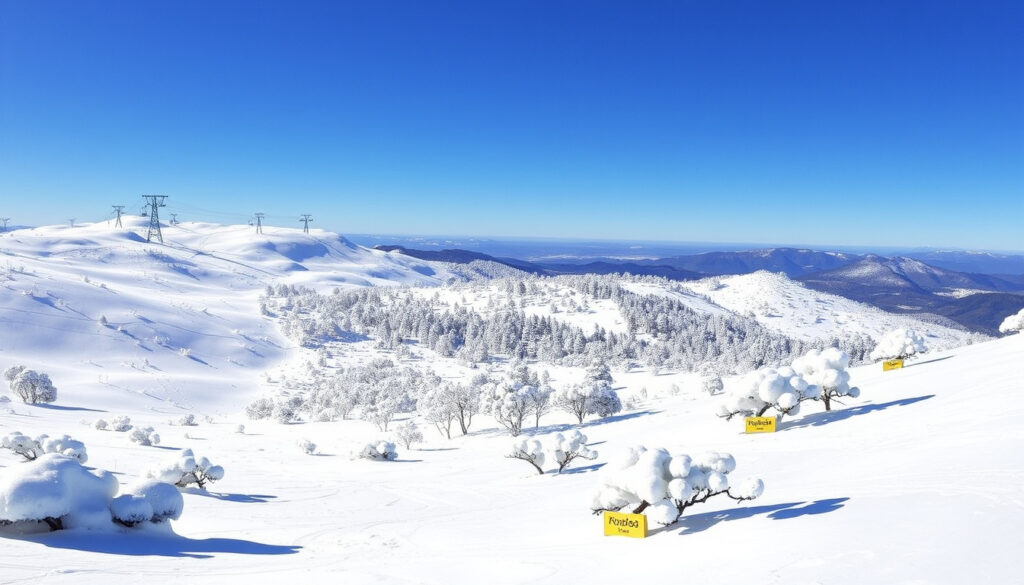
Mount Buller Ski Trip Guide: Snow, Costs & Best Time
Planning a ski trip to Mount Buller sounds straightforward — until you start adding up the lift tickets, accommodation, and the nagging question of whether there’ll actually be snow. This guide cuts through the marketing to give you real costs, snow reliability data, and the best timing for your Australian ski holiday. You’ll walk away with a clear budget and a smarter plan.
Elevation: 1605 m (5266 ft) ·
Skiable terrain: 300+ hectares ·
Ski lifts: 22 ·
Distance from Melbourne: 3 hours by car ·
Average annual snowfall: 2.5 m (100 in) ·
Snow season: June to October
Quick snapshot
- Natural and machine-made snow (Mt Buller (official snow report))
- 22 lifts including 1 gondola (Snow-Forecast (weather modeling service))
- 300+ hectares terrain (Skiresort.info (snow depth aggregator))
- Beginner to expert runs (Mt Buller (official snow report))
- Lift passes: AUD 142–180/day (Mt Buller (official pricing))
- Accommodation: AUD 200–600/night (Mt Buller (accommodation page))
- Meals: AUD 30–50/meal (Mt Buller (official pricing))
- Season passes available (OnTheSnow (lift ticket aggregator))
- 3-hour drive from Melbourne (Sightseeing Tours Australia (transport options))
- Bus services available (Sightseeing Tours Australia (tourism operator))
- No direct flights (Sightseeing Tours Australia (transport options))
- Car parking on mountain (Sightseeing Tours Australia (transport options))
- August: most snow (Snow-Forecast (weather modeling service))
- July: good snow but busy (Sightseeing Tours Australia (tourism operator))
- Late September: cheaper + quieter (Snow-Forecast (weather modeling service))
- Check snow forecast before booking (Snow-Forecast (weather modeling service))
Eight key figures sum up what Mount Buller offers — a compact but capable resort that relies on both nature and technology.
| Attribute | Value |
|---|---|
| Location | Victoria, Australia, 240 km NE of Melbourne |
| Elevation | 1605 m (5266 ft) |
| Ski season | June to October (14–16 weeks) |
| Lifts | 22 (including 1 gondola) |
| Skiable area | 300+ hectares |
| Average snowfall | 2.5 m per season |
| Snowmaking | Covers 38% of terrain (Mt Buller (snow report)) |
| Distance from Melbourne | 3 hours by car (208 km) |
The pattern: Moderate elevation and active snowmaking create a reliable season, but the resort is small by global standards — which directly shapes costs and crowding.
Is Mount Buller real or fake snow?
- Mount Buller uses both natural and machine-made snow (Mt Buller (official snow report)).
- Snowmaking covers 38% of terrain (Skiresort.info (snow depth aggregator)).
- Natural snow base averages 40–80 cm mid-winter (Skiresort.info (snow depth aggregator)).
How does Mount Buller make snow?
- The resort operates snowmaking equipment across the lower and intermediate runs, supplementing natural snowfall to maintain a skiable base. According to Mt Buller (resort site), the system covers 38% of trails, focusing on the most trafficked areas.
- A Mt Buller (resort notice) noted that from late June onward, lift ticket and lesson sales were limited to preserve snow quality — a sign that the resort actively manages its artificial snow surface.
When does Mount Buller use natural snow only?
- Natural snow dominates when the seasonal total exceeds 2.5 m, which typically happens in July and August (Snow-Forecast (weather modeling service)).
- In early season (June) and late season (October), the resort relies heavily on snowmaking to maintain coverage.
Snowmaking guarantees a base, but it costs energy and money — costs passed on to lift ticket prices. For skiers who prefer only natural snow, August is the only reliable window.
The implication: The “real or fake” question misses the point — what matters is coverage. And with 38% machine-made, Mount Buller can open on schedule even when nature doesn’t cooperate.
Does Mount Buller always have snow?
- Snow depth varies year-to-year; the season runs June–October with variable cover (Skiresort.info (snow depth data)).
- Snowmaking ensures base for main runs (Mt Buller (snow report)).
What is snow reliability like in July?
- July typically sees natural snow building, with average depths of 40–60 cm at mid-mountain (Skiresort.info (snow depth aggregator)).
- Snowmaking supplements cover on lower runs, making most trails skiable even in lower-snow years.
How does El Niño affect Mount Buller?
- El Niño years in southeast Australia are associated with drier, warmer winters, which can reduce natural snowfall (Snow-Forecast (climatic context)).
- In El Niño seasons, snowmaking becomes even more critical; the resort’s 38% coverage provides a buffer but doesn’t guarantee every run.
What this means: “Always” is too strong. But thanks to snowmaking, the main runs are skiable through the core season in most years. Budget travellers should aim for August for the highest probability.
How cold is it on Mount Buller?
- Average mid-winter daytime temperature: -2°C to 2°C (Snow-Forecast (mid-mountain forecast)).
- Night temps drop below -5°C.
- Wind chill can make it feel 5–10°C colder (Snow-Forecast (mid-mountain forecast)).
What is the average winter temperature?
- Daytime highs in July and August hover around freezing, with overnight lows often hitting -5°C to -8°C (Snow-Forecast (mid-mountain forecast)).
What is wind chill like on the mountain?
- The exposed summit and higher lifts amplify wind chill. At 1605 m, the combination of below-zero temps and 30+ km/h winds can produce a “feels like” reading of -10°C or lower (Snow-Forecast (wind data)).
Many first-time visitors underestimate wind chill. The real danger isn’t the thermometer — it’s exposed skin in a moderate breeze. Face masks and quality gloves aren’t optional.
The pattern: Mount Buller is genuinely cold by Australian standards, but not extreme. The real issue is preparedness: most visitors from warmer climates don’t pack enough layers.
How much does a trip to Mount Buller cost?
- Lift tickets: AUD 142–180 per day for adults (Mt Buller (official pricing)). Early-bird deals dropped to as low as AUD 126/day (Mt Buller Facebook (promotion)).
- Accommodation: AUD 200–600 per night for on-mountain options.
- Meals: AUD 30–50 per meal.
- Total weekend trip for a family of 4: ~AUD 2,500–4,000 (estimated based on 2-day lift passes + 1 night accommodation + meals + gear).
What is the lift ticket price?
- Full-day adult passes are typically AUD 150–180. Half-day and multi-day options also exist (OnTheSnow (lift ticket aggregator)). Season passes reduce the per-day cost significantly.
How much is accommodation per night?
- On-mountain accommodation ranges from AUD 200 (budget lodges) to AUD 600+ (hotels and apartments). Off-mountain options in Mansfield (45 min drive) are cheaper, typically AUD 150–250/night.
Are there package deals?
- Some travel agencies offer combined lift-and-accommodation packages. Adventure Snow Tours (tour operator) lists package options, though booking directly with the resort is often cheaper for independent travellers.
The implication: For a family of four, a single weekend can easily cost AUD 3,000. That’s the price of a short overseas trip — and the main reason Australian skiing feels expensive.
What is the best month to visit Mount Buller?
- August has the deepest snowpack and best snow reliability (Snow-Forecast (snowiest week data)).
- July and August are busiest and most expensive.
- Late June can have thin cover; September offers fewer crowds and decent snow.
Is August the best month?
- Snow-Forecast data shows the snowiest week is the first week of August, averaging 3.4 snowy days and 22 cm of fresh snow (Snow-Forecast (resort guide)). For snow quality, August is the clear winner.
What about school holidays?
- Victorian school holidays in July and early September bring peak crowds. Accommodation prices jump, and lift queues grow significantly. Adventure Snow Tours (tour operator) recommends avoiding mid-July if possible.
Is June too early?
- Late June often has limited natural snow, but snowmaking covers lower runs. The base may be thin, and only about 30–40% of trails are open (Mt Buller (snow report)).
The trade-off: August offers the best snow but the highest prices. September gives you nearly as good conditions at a discount — if you can handle the occasional warm afternoon.
Why is skiing so expensive in Australia?
- Limited terrain vs. global resorts (Skiresort.info (terrain data)).
- High operational costs (energy for snowmaking, transport).
- Short season (14–16 weeks) concentrates costs into fewer days.
- Few resorts reduce competition.
How does Australia compare to New Zealand?
- New Zealand resorts like Queenstown offer larger terrain, more reliable natural snow, and lower lift prices — often AUD 120–150/day vs. Mount Buller’s AUD 150–180 (OnTheSnow (price comparison data)). Flights and accommodation shift the total cost, but for a pure ski holiday, NZ often edges out Australia.
Are there cheaper days to ski?
- Mount Buller offers early-bird discounts and limited-time promotions, like the AUD 126/day deal advertised on Mt Buller Facebook (promotion). Weekdays are generally cheaper than weekends.
The pattern: Australia’s skiing isn’t expensive because of greed — it’s expensive because of scale. Short seasons and high fixed costs mean every skier foots a bigger bill. For an overseas alternative, read our guide on Melbourne to Japan: Direct, Cost, Best Time & Budget.
What is the snowiest town in Australia?
- Perisher receives the most snow (average 2.9 m) (Skiresort.info (snowfall comparison)).
- Mount Buller averages 2.5 m.
- Thredbo averages 2.0 m.
Is Mount Buller the snowiest?
- No. Perisher in New South Wales consistently records the highest natural snowfall among Australian resorts.
Which resort gets most natural snow?
- Perisher leads, then Mount Buller, then Thredbo. However, snowfall variability means ranking can change year to year (Snow-Forecast (climate data)).
The implication: Mount Buller isn’t the snowiest resort in Australia, but its snowmaking compensates — giving it a more consistent season than Thredbo, which relies more heavily on natural cover.
Upsides
- Close to Melbourne (3 hours)
- Reliable snowmaking covering 38% of terrain
- Good beginner runs and ski school options
- Scenic setting with year-round activities
Downsides
- Expensive compared to overseas resorts
- Variable natural snow from year to year
- Can get very crowded on weekends and school holidays
- Limited terrain compared to Perisher or NZ resorts
How to Plan Your Mount Buller Ski Trip
Step 1: Check the snow report
- Visit the official Mt Buller (snow report page) at 8am daily for conditions.
- Download the Buller Live App for live updates (Mt Buller (app information)).
Step 2: Book accommodation early
- On-mountain lodges book out weeks ahead for July and August. Reserve at least 1–2 months in advance.
- Consider Mansfield as a cheaper alternative (45-minute drive).
Step 3: Buy lift passes online
- Purchase from Mt Buller (lift passes page) to avoid day-of queues. Early-bird prices start at ~AUD 126.
- Season passes offer best value for 5+ days.
Step 4: Pack for cold weather
- Temperatures range from -5°C to 2°C; wind chill can drop to -10°C. Bring base layers, waterproof outerwear, gloves, and a balaclava.
Step 5: Arrange transport
- Driving from Melbourne takes about 3 hours. Snow chains may be required — check conditions before leaving (Sightseeing Tours Australia (transport options)).
- Coach services run from Melbourne if you don’t have a 4WD (Sightseeing Tours Australia (transport options)).
Step 6: Consider lessons
- Beginners should book a lesson package. The resort’s ski school covers basics on gentle slopes (Mt Buller (activities page)).
Confirmed facts vs. what’s unclear
Confirmed facts
- Mount Buller uses snowmaking on 38% of trails (Mt Buller (resort site))
- Ski season runs June–October (Mt Buller (official site))
- Average elevation is 1605 m
- Distance from Melbourne is ~3 hours
What’s unclear
- Exact snow depth for any given week (weather-dependent)
- Future 2026 snowfall patterns
- Exact annual snowfall total varies year to year
- Snow depth at base vs mountain can differ significantly
What others say about Mount Buller
“Our snowmaking covers 38% of trails, ensuring a reliable base even in low-snow seasons. We always encourage checking the 8am daily report for the latest conditions.”
— Mount Buller Resort spokesperson (Mt Buller (official website))
“Mount Buller’s snow depth data shows consistent coverage from July onward, though early June can be thin. The resort’s snowmaking helps bridge the gap.”
— Skiresort.info reviewer (Skiresort.info (snow depth aggregator))
“Beyond skiing, Mount Buller offers year-round activities like mountain biking, hiking, and scenic chairlift rides — making it a destination for more than just winter.”
— Visit Victoria tourism board (Visit Victoria (state tourism site))
The takeaway: The resort markets itself honestly about snowmaking, and independent sources back up the snow depth trends. The gap between marketing and reality is smaller than at many other Australian resorts.
Can you drive to Mount Buller without a 4WD?
Yes, but you may need to fit snow chains depending on road conditions. The resort road is sealed but can become icy. Check the daily report at Sightseeing Tours Australia (transport options).
Are there beginner ski lessons at Mount Buller?
Yes, the resort’s ski school offers group and private lessons on dedicated beginner slopes (Mt Buller (activities page)).
Do you need chains for Mount Buller?
Chains are often required when snow or ice is on the road. The resort advises carrying them and checking conditions before departure.
Is Mount Buller open in summer?
Yes, Mount Buller is open year-round. Green-season activities run from November to April (Mt Buller (activities page)). For a different kind of summer adventure, check out Jamberoo Water Park 2025 Guide: Prices, Worth & Tips.
What is the altitude sickness risk at Mount Buller?
At 1605 m, altitude sickness is very rare. Most visitors experience no issues, though those sensitive to altitude might feel slight breathlessness when exerting (Skiresort.info (resort data)).
Are dogs allowed at Mount Buller?
Dogs are not permitted on ski trails or in village areas during winter. Summer access is more flexible, but check the resort’s pet policy.
What is the nearest airport to Mount Buller?
The nearest major airport is Melbourne Airport (MEL), about 3 hours’ drive away. There are no direct flights to the mountain.
Can you use a season pass at other Australian resorts?
Mount Buller’s season pass is valid only at Mount Buller. Some multi-resort passes (like Epic Australia) include it, but the resort’s own pass does not cross over.
For families on a budget, the choice is clear: book a mid-week trip in late August, buy passes early, and stay in on-mountain accommodation to avoid the worst of the crowds — or risk paying double for a weekend in July. Mount Buller can deliver a great Australian ski holiday, but only if you plan around its quirks and costs.
snow-forecast.com, mtbuller.com.au, onthesnow.com, reddit.com
For a deeper breakdown of snow conditions and seasonal prices, check out this comprehensive Mount Buller guide that also covers off-peak discounts and accommodation options.
More related posts
 Chris Hemsworth: Biography, Alzheimer’s Risk & Family
 Victoria Justice: Age, Height, Ethnicity & Illness (2025)
 Andrea Lam: ARIA-winning Australian pianist biography
 Matt LeBlanc: Why He Quit Acting and His Daughter’s Health
 Nick Fuentes: Verified Facts, Timeline, and Official Sources
 Sandra Sully: What Happened to the Australian News Presenter
 Man City vs Napoli Lineups: Confirmed Starting XIs (18 Sept 2025)
 Queens of the Stone Age – History, Members, Albums and Tours