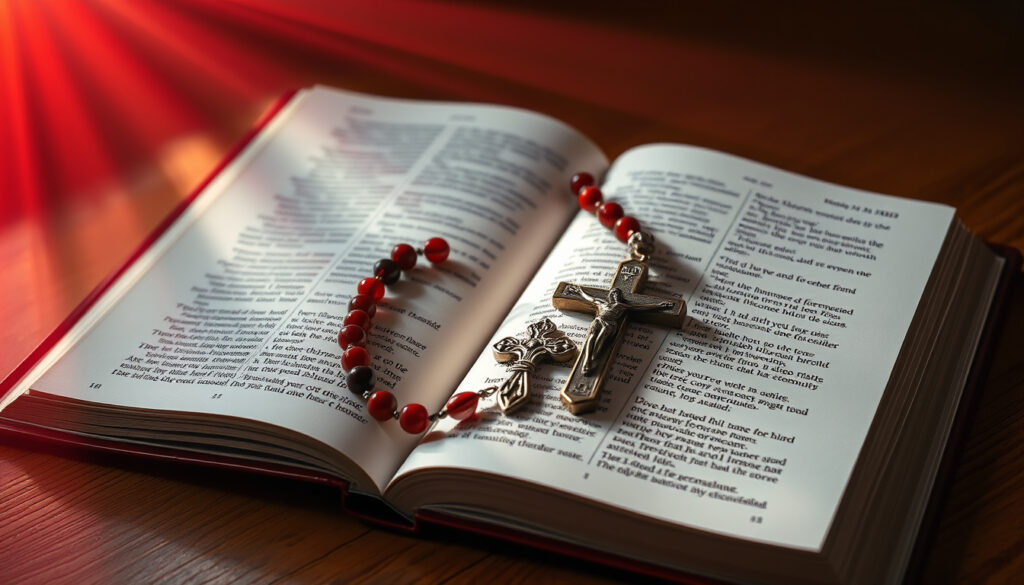
Divine Mercy Chaplet: How to Pray Step-by-Step Guide
The Divine Mercy Chaplet distills Christ’s promise of mercy into five focused decades—recited in minutes, prayed worldwide since Jesus asked for it at 3 p.m. From the Diary of Saint Faustina, this devotion became the rare Catholic prayer the Church once restricted, then canonized.
Beads Used: Ordinary rosary beads of five decades ·
Recommended Time: 3 p.m. daily ·
Preceded By: Two opening prayers from Diary of Saint Faustina ·
Origin Source: Diary of Saint Faustina
Quick snapshot
- Recitation on rosary beads per The Divine Mercy
- USCCB official prayer text (USCCB)
- 3 p.m. Hour of Mercy from shrine schedule (Focus.org)
- Exact reasons behind the 1959-1978 Church restriction
- 1959-1978: Church restriction · USCCB
- Canonization of St. Faustina in 2000 · The Divine Mercy
The key facts table covers five critical data points that define how the Chaplet is structured, when it should be prayed, and the historical trajectory from restriction to universal acceptance.
| Label | Value |
|---|---|
| Structure | 5 decades like rosary |
| Source | Diary of Saint Faustina |
| Beads Required | Ordinary rosary preferred |
| Ideal Time | 3 p.m. Hour of Mercy |
| Ban Period | 1959-1978 |
How to Pray the Chaplet of Divine Mercy?
The Chaplet follows a clear, repeatable structure that takes just a few minutes once you know the prayers. Here’s the official sequence from the United States Conference of Catholic Bishops and the saint’s own Diary.
Opening prayers
Begin with the Sign of the Cross: “In the name of the Father, and of the Son, and of the Holy Spirit. Amen.” (Focus.org guide)
Optional opening prayer—repeat three times: “You expired, Jesus, but the source of life gushed forth for souls and the fount of mercy opened for us.” (USCCB instructions)
Then repeat three times: “O Blood and Water, which gushed forth from the Heart of Jesus as a fount of mercy for us, I trust in You!” (Focus.org guide)
Our Father beads
On the large bead before each decade, pray the Eternal Father prayer: “Eternal Father, I offer You the Body and Blood, Soul and Divinity of Your dearly beloved Son, Our Lord Jesus Christ, in atonement for our sins and those of the whole world.” (USCCB instructions)
Hail Mary beads
On each of the 10 small beads of the decade, pray: “For the sake of His sorrowful Passion, have mercy on us and on the whole world.” (The Divine Mercy site)
Repeat for five decades. (St. Paul of the Cross parish guide)
Closing prayer
After the five decades, pray the concluding prayer three times: “Holy God, Holy Mighty One, Holy Immortal One, have mercy on us and on the whole world.” (SVDP Houston guide)
Optional closing: “Eternal God, in whom mercy is endless and the treasury of mercy is inexhaustible, look kindly upon us and grant us mercy.” (Focus.org guide)
End with “Jesus, I trust in You” three times. (YouTube tutorial)
The implication: once you’ve prayed it once or twice with a guide, you won’t need one again. This is a devotion designed to become second nature.
Do You Need a Rosary to Pray the Divine Mercy Chaplet?
No special equipment is required. Ordinary rosary beads of five decades are the standard, but the Chaplet can be prayed completely bead-free.
Using rosary beads
The beads serve as a physical guide through the decades—nothing magical about them. (St. Paul of the Cross parish guide)
The USCCB provides the official English text, which shows exactly how the five decades map onto a standard rosary set. (USCCB prayer text)
Alternatives without beads
Count on your fingers if beads aren’t available. Five groups of ten keep track of the decades just fine.
Jesus asked for this devotion to reach everyone—even people with nothing. No beads means no barrier to starting today.
The pattern: the Chaplet is the rare Catholic devotion that requires absolutely nothing you don’t already have.
How to Recite the 3 O’Clock Divine Mercy Prayer?
While the Chaplet can be prayed at any hour, 3 p.m. carries specific significance rooted in the revelation to Saint Faustina.
Timing significance
Ideally prayed at 3 PM, the Hour of Mercy—that is when Christ hung dying on the cross. (Focus.org guide)
The USCCB specifically promotes praying the Chaplet at 3 PM as a prayer for healing from abortion. (USCCB pro-life ministry)
Full 3 p.m. recitation
The Divine Mercy Shrine holds a Holy Hour at 3 p.m. daily for those who can attend in person. For remote participants, several parishes stream the prayer live.
Pray for intentions like the dying, souls in purgatory, conversion, and peace. (Focus.org guide)
Jesus asked for this hour by name—making 3 p.m. spiritually significant even if you can’t always hit it exactly.
The trade-off: missing 3 p.m. occasionally doesn’t invalidate the practice, but making it a daily habit at that hour builds something the tradition calls the “Hour of Mercy.”
When to Start Saying the Divine Mercy Chaplet?
Anytime is the right time to begin. No waiting period, no prerequisites, no requirement to start on a particular day.
Best times
While 3 p.m. is ideal, prayer at any hour counts. Many find that starting with a specific intention—say, for a dying loved one—makes the practice more meaningful from the first attempt. (Focus.org guide)
Daily or novena
Pray daily for consistency, focusing on Christ’s passion. Community prayer also strengthens faith. (Focus.org guide)
The nine-day novena from Good Friday to the Saturday before Divine Mercy Sunday is a popular structured approach. (Hallow app guide)
Divine Mercy Sunday falls on the Second Sunday of Easter—making Easter the natural launch point for a novena. (USCCB feast page)
The catch: starting a new prayer habit requires consistency, but the Chaplet is short enough that skipping it feels harder than doing it.
Why Was the Chaplet of Divine Mercy Banned?
The Chaplet faced Church restriction from 1959 to 1978. While the precise internal Vatican reasons aren’t fully documented in public sources, several factors contributed to the lifting of the ban.
1959-1978 period
The restriction was lifted in 1978. (USCCB feast page)
St. Faustina was canonized in 2000, establishing Divine Mercy Sunday universally that same year. (The Divine Mercy site)
Reasons and lifting
The key concerns centered on the novel prayers in the Chaplet that weren’t part of standard Catholic liturgy at the time, and broader questions about the Divine Mercy theology itself. After theological review, the Vatican removed all restrictions. (USCCB feast page)
Specific Vatican correspondence or official documentation explaining the 1959-1978 restriction isn’t publicly available, leaving some historical gaps about the decision-making process.
What this means: the Church ultimately discerned that the devotion was theologically sound. Today’s faithful can pray it with full confidence that the Church has weighed in.
Step-by-Step Guide
Here’s the complete sequence in practice order—opening prayers through the closing—for praying the Divine Mercy Chaplet.
Step 1: Opening
- Sign of the Cross.
- Optional: “You expired, Jesus…” (three times).
- “O Blood and Water, which gushed forth from the Heart of Jesus as a fount of mercy for us, I trust in You!” (three times).
Step 2: Apostles’ Creed
- Pray the Apostles’ Creed. (CatholicTV video guide)
Step 3: Five Decades
- On the large bead before each decade: Eternal Father prayer.
- On each of the 10 small beads: “For the sake of His sorrowful Passion, have mercy on us and on the whole world.”
- Repeat for five decades.
Step 4: Closing
- “Holy God, Holy Mighty One, Holy Immortal One, have mercy on us and on the whole world.” (three times). (SVDP Houston guide)
- Optional: “Eternal God, in whom mercy is endless…”
- “Jesus, I trust in You” (three times). (YouTube tutorial)
Confirmed Facts vs. What’s Still Unclear
The research shows strong documentation on some points, with remaining gaps on others.
Confirmed
- Recitation on rosary beads per The Divine Mercy site
- USCCB official prayer text (USCCB text)
- 3 p.m. Hour of Mercy from shrine schedule (Focus.org guide)
Unclear
- Exact reasons behind the 1959-1978 Church restriction beyond general concerns about novel prayers and theology
The pattern: the practical mechanics of the Chaplet (how to pray it, when, with what tools) are thoroughly documented. The internal Church deliberations from 1959-1978 remain partially opaque.
What the Tradition Says
“Whoever will recite it will receive great mercy at the hour of death.”
— Jesus (per Diary, no. 687, USCCB feast page)
“Encourage souls to say the chaplet which I have given you.”
— Jesus (per Diary, no. 1541, USCCB feast page)
“Even if there were a sinner most hardened, if he were to recite this chaplet only once, he would receive grace from My infinite mercy.”
— Jesus (per Diary, no. 687, USCCB feast page)
The implication: Jesus made these promises specific and concrete—not vague spiritual hope but a defined outcome attached to a defined action. That framing shapes how the Church presents the Chaplet today.
For Catholics looking for a direct, accessible entry point into the Divine Mercy message, the Chaplet is the clearest path forward. Jesus asked for it to be simple—five decades, a handful of prayers, a few minutes—and He promised mercy in return. There’s no reason to wait.
Related reading: Angels and Demons · Alita Battle Angel
Frequently Asked Questions
What is the Divine Mercy Chaplet?
A short Catholic devotion centered on God’s mercy, drawn from the Diary of Saint Faustina Kowalska. It uses ordinary rosary beads and focuses on Christ’s suffering as the source of divine mercy for the world.
How long does the Divine Mercy Chaplet take?
Typically 5-10 minutes depending on pace. The prayers are short and the structure is straightforward.
Where can I find a Divine Mercy Chaplet PDF?
The USCCB publishes the official English text directly on their website.
Is the Divine Mercy Chaplet part of a novena?
It can be prayed as part of a nine-day novena before Divine Mercy Sunday, but it also stands alone as a daily devotion with no required format.
Who revealed the Divine Mercy Chaplet?
Jesus revealed it to Saint Maria Faustina Kowalska in the 1930s, and she recorded the prayers and promises in her Diary.
Can the Divine Mercy Chaplet be prayed without beads?
Yes. Counting on fingers works perfectly fine—five groups of ten tracks the decades accurately.
Does the Church officially approve the Divine Mercy Chaplet?
Yes. The USCCB publishes the official text, St. Faustina was canonized in 2000, and Divine Mercy Sunday is celebrated universally.
More related posts
 Diane Kruger Biography: Age, Net Worth, Relationship, Movies
 Queens of the Stone Age – Members, History, Albums and Tours
 Toyo Open Country AT3 – Review, Specs & Prices Australia
 Janis Joplin: Cause of Death, Last Words, and Legacy
 Myer Gift Card – Check Balance, Buy and Full Guide
 Xolo Maridueña: Age, Height, Relationships & Career
 Alita Battle Angel – Plot Cast Sequel Streaming Guide
 Nick Fuentes: Verified Facts, Timeline, and Official Sources