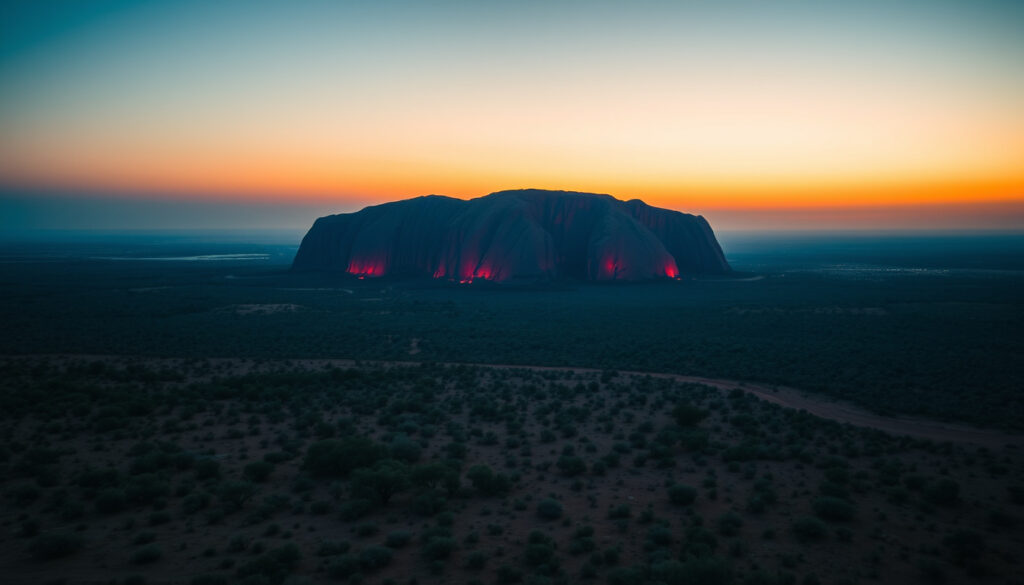
Ayers Rock (Uluru): Why It’s Not Called That & Visitor Guide
If you’ve seen photos of Australia’s Red Centre, you know the rock. But the story behind its name — and why you’re supposed to call it something else — is where the real journey begins. This guide walks through the cultural tensions, geological history, and practical logistics of visiting what is officially known as Uluru / Ayers Rock, one of the country’s most sacred and visited landmarks.
Height: 348 m (1,142 ft) ·
Circumference: 9.4 km (5.8 mi) ·
Age: ~500 million years ·
Climbing ban effective: October 26, 2019 ·
Annual visitors: ~300,000 ·
Traditional custodians: Anangu people
Quick snapshot
- Northern Territory, Australia (Tourism Australia – national tourism bureau)
- 450 km from Alice Springs (Tourism Australia)
- Part of Uluṟu-Kata Tjuṯa National Park (Parks Australia – government park authority)
- Height: 348 m (Parks Australia)
- Circumference: 9.4 km (Parks Australia)
- Age: ~500 million years (Tourism Australia)
- Dual name: Uluru / Ayers Rock (Parks Australia)
- Traditional Anangu name: Uluru (Parks Australia)
- Colonial name: Ayers Rock (1873) (National Museum of Australia – national history institution)
- Permanently closed October 26, 2019 (Parks Australia)
- At request of Anangu custodians (Parks Australia)
- Base walk still open (Ayers Rock Resort – local tourism operator)
| Attribute | Value |
|---|---|
| Height | 348 m (1,142 ft) |
| Circumference | 9.4 km (5.8 mi) |
| Establishment of national park | 1958 (as Ayers Rock–Mt Olga National Park) |
| Return to Anangu | 1985 |
| Climbing ban date | October 26, 2019 |
| Annual rainfall | ~300 mm |
Why is it not called Ayers Rock?
Because the rock never had that name to begin with — not for the people who lived there for tens of thousands of years. The explorer William Gosse sighted the monolith in 1873 and named it after Sir Henry Ayers, a South Australian premier at the time. But the Anangu people had always called it Uluru, a name with no known literal translation in their language but one that carries deep spiritual and ancestral meaning. In 1993, the site was officially given dual name status: Uluru / Ayers Rock. Today, many Australians and tourism operators refer to it simply as Uluru, though the European name persists in some contexts.
What is the origin of the name Ayers Rock?
- William Gosse, an explorer, named it in 1873 (National Museum of Australia).
- It honored Sir Henry Ayers, a colonial politician (National Museum of Australia).
- The Anangu had used the name Uluru for millennia (Parks Australia).
What does Uluru mean?
There is no direct English translation for the word Uluru in the Pitjantjatjara language spoken by the Anangu people. It is an ancient name, not a descriptive label. It refers both to the physical rock and to the ancestral beings whose stories are woven into its caves, cracks, and waterholes. That lack of translation is itself a clue: it is not a decoration; it is a place name in the deepest sense.
The implication: What gets called a “translation problem” is actually a cultural boundary. The word resists simple borrowing.
What’s so special about Ayers Rock?
The rock appears as a single massive slab, but its story runs much deeper. Uluru is a sandstone monolith that stands 348 meters above the desert floor and extends perhaps several more kilometers underground. Yet what makes it extraordinary isn’t just its size — it is how it commands the landscape and the cultural weight it carries.
How tall is Uluru?
- 348 m (1,142 ft) high above the surrounding plain (Parks Australia).
- Circumference of 9.4 km (5.8 mi) (Parks Australia).
- It is part of the same geological formation as Kata Tjuta (The Olgas), about 25 km away (Tourism Australia).
At 348 meters, Uluru is taller than the Eiffel Tower (300 m) but far wider — a slab of rock that covers the equivalent of about 400 football fields. The sheer mass is what makes it visible from space.
Why does Uluru change color?
- The rock’s surface contains iron oxide (Tourism Australia).
- At sunrise and sunset, it shifts from deep orange to vivid red to sometimes purple (Tourism Australia).
- The effect is strongest during the dry season (May–September) (Tourism Australia).
The pattern: Uluru is not just a rock that sits still. It performs. The color change is the most photographed natural phenomenon in the Australian outback, but the deeper performance is cultural — the rock is alive with story.
Why are tourists not allowed to climb Uluru anymore?
For decades, climbing Uluru was a standard item on visitor bucket lists. But it was also a wound that refused to heal. The Anangu people had long asked visitors not to climb, explaining that the route follows the ancestral path taken by Mala men in the Tjukurpa (creation stories). Climbing was not just physically dangerous — it was spiritually disrespectful. After years of declining numbers and shifting public sentiment, the park’s Board of Management made the closure final.
When did the climbing ban start?
- The ban took effect on October 26, 2019 (Parks Australia).
- That date marked the 34th anniversary of the Handback of the park to Anangu in 1985 (Parks Australia).
- The Board of Management agreed unanimously in November 2017 to close the climb after climber numbers fell below 20% of visitors (Parks Australia).
Can you still walk around Uluru?
- Yes — the 10.6 km base walk is fully open (Ayers Rock Resort).
- Walking is permitted and encouraged as a respectful way to experience the site (Parks Australia).
- Penalties apply for anyone attempting to climb under the Environment Protection and Biodiversity Conservation Act (Parks Australia).
Climbing Uluru is a federal offence. Parks Australia has stated that visitors attempting it can face penalties under environmental law. This is not a suggestion — it’s a legal prohibition.
Can you swim at Uluru?
The short answer: no swimming on the rock itself. The Mutitjulu Waterhole at the base of Uluru is a sacred site and strictly off-limits for swimming. But if you’re in the region during the hot season, there are a few options — with conditions.
Are there any swimming holes near Uluru?
- The Mutitjulu Waterhole at Uluru is considered sacred and not for swimming (Parks Australia).
- Some waterholes in the Kata Tjuta (The Olgas) area may allow wading but not swimming (Parks Australia).
- The closest swimming pools are at Ayers Rock Resort and in Alice Springs (450 km away) (Ayers Rock Resort).
What are the safety warnings?
- Flash flooding can occur rapidly in the desert after rain (Tourism Australia).
- Waterholes in the park may contain bacteria and are not treated (Parks Australia).
- Crocodiles are not present, but extreme heat and dehydration are real risks during summer (October–April) (Tourism Australia).
The trade-off: You can cool off at the resort pool, but the magic of desert swimming remains mostly a myth. Respect the waterholes — they hold spiritual significance and, in some cases, genuine danger.
What is the closest city to Ayers Rock?
Alice Springs is the nearest town with full services, sitting about 450 km northeast. But the real gateway for most visitors is the Ayers Rock Airport (Connellan Airport, code AYQ), which is just 20 km from the rock itself.
What is the best way to get to Ayers Rock?
- Fly into Ayers Rock Airport (AYQ) from Sydney, Melbourne, or Brisbane (Tourism Australia).
- Drive 5 hours from Alice Springs along the Stuart and Lasseter Highways (Tourism Australia).
- Bus tours from Alice Springs and Ayers Rock Resort are common (Ayers Rock Resort).
Where is Ayers Rock Resort?
- Ayers Rock Resort is located in the town of Yulara, 20 km from the rock (Ayers Rock Resort).
- It offers hotels, camping, restaurants, and a pool (Ayers Rock Resort).
- Entry to Uluṟu-Kata Tjuṯa National Park is separate and requires a pass (Parks Australia).
Timeline
- c. 500 million years ago – Uluru sandstone formed (Tourism Australia)
- 1873 – Explorer William Gosse names it Ayers Rock after Sir Henry Ayers (National Museum of Australia)
- 1958 – Area declared Ayers Rock–Mt Olga National Park (Parks Australia)
- 1985 – Title handed back to Anangu, who lease it back to Parks Australia (National Museum of Australia)
- 1993 – Official dual naming: Uluru / Ayers Rock (Parks Australia)
- October 26, 2019 – Permanent climbing ban takes effect (Parks Australia)
Confirmed facts vs what’s unclear
Confirmed facts
- Height: 348 m (Parks Australia)
- Climbing ban in effect since Oct 26, 2019 (Parks Australia)
- Dual official name Uluru / Ayers Rock (Parks Australia)
- Returned to Anangu in 1985 (National Museum of Australia)
What’s unclear
- Exact year of first human occupation at Uluru (debated among archaeologists) (National Museum of Australia)
- Precise geological age – estimates range from 500–600 million years (Tourism Australia)
Voices from the site
Uluru is not a playground. It is a sacred place, part of our living culture. We ask visitors to respect it the way we do.
— Anangu elder (as cited by Parks Australia)
The climb has always been dangerous. More than 35 people have died attempting it. But the cultural reasons for closing it were always the primary ones.
— Parks Australia spokesperson (as cited by Parks Australia)
When the climb closed, it felt like a burden lifted. We could finally tell our story on our terms.
— Anangu representative (as cited by National Museum of Australia)
Visitors today come with more awareness. They want to learn, not just take a photo.
— Ayers Rock Resort guide (as cited by Ayers Rock Resort)
Summary
The story of Uluru / Ayers Rock is not a simple tourism fact sheet. It is a case study in how a country confronts its colonial past through a single rock formation. For the Australian traveler, the choice is clear: learn the Anangu name, walk the base trail, and respect the ban. For international visitors, the implication is the same — the rock is not a souvenir; it is a living archive.
instagram.com, ulurutoursaustralia.com.au, en.wikipedia.org, yarn.com.au, reddit.com, abc.net.au, en.wikipedia.org, uluru.gov.au
For those planning a visit, it’s essential to understand the climbing ban and visitor rules that now apply to this sacred site.
Frequently asked questions
How long does the base walk take?
The full 10.6 km loop takes about 3 to 4 hours at a steady pace, depending on heat and stops.
Is Uluru open at night?
The national park is open from sunrise to sunset. Overnight entry is not permitted.
Can I take a helicopter tour over Uluru?
Yes, several operators offer scenic flights from Ayers Rock Airport and Alice Springs.
What is the entry fee for Uluṟu-Kata Tjuṯa National Park?
As of 2025, an adult pass costs approximately AUD 40 per person, valid for 3 days.
What accommodation is at Ayers Rock Resort?
The resort offers hotels, apartments, camping, and caravan sites, plus dining and a pool.
Do I need a permit to visit?
No permit is required; purchase an entry pass at the park gate or online.
What is the weather like in summer?
Summer (October–April) sees daytime highs above 40°C. Visit early morning or late afternoon.
Are dogs allowed in the park?
No, dogs are not permitted in Uluṟu-Kata Tjuṯa National Park, including in vehicles.
Related reading
More related posts
 Tea Tree Oil: Uses, Benefits, Side Effects, Safety
 Agnes Moorehead: Cause of Death, Net Worth & Legacy
 CommBank Unfair Fees Refund Petition – Status and Refund Guide
 Lynas Rare Earths (ASX:LYC) Stock Analysis: Is LYC a Buy?
 Thelma Riley: Ozzy Osbourne’s First Wife – Life, Children, Now
 Gordon River Cruise: Worth It, Prices & How to Choose
 Lee Pace: Height, Husband, Career, and Coming Out Guide
 Ronaldo Mulitalo: Ethnicity, Injury, and Origin Eligibility